IPTV Service Providers: How to Choose the Right One in 2026
Most IPTV shoppers compare five providers and still guess. This guide gives you the exact criteria — pricing, trials, uptime, support — so you can judge any service in ten minutes.
- 8 objective selection criteria
- Real 2026 price ranges
- Verified vs unverified explained
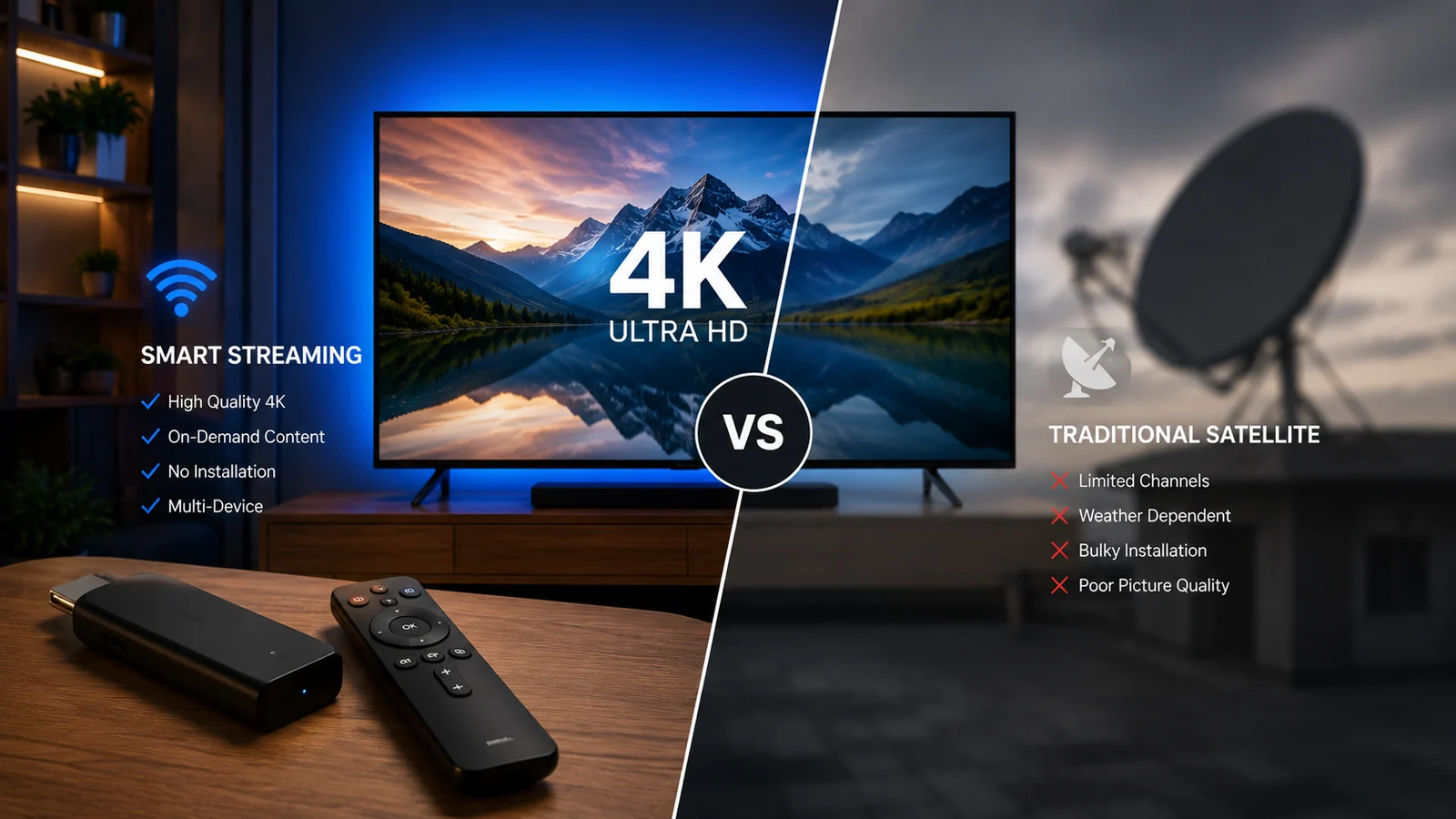
Choosing an IPTV service provider in 2026 comes down to a short list of verifiable facts: what a subscription costs, whether you can test it before paying, how the streams hold up during peak hours, and who answers when something breaks. The IPTV market is crowded with services that look identical on the surface — big channel counts, bold uptime claims, near-identical pricing. This pillar guide explains how the technology works, what separates verified from unverified services under US law, the eight criteria worth checking on any provider, and how Watchit measures against each one. By the end, you will know exactly what to test during a trial.
What a Serious IPTV Provider Actually Delivers
Strip away the marketing and four things determine whether an IPTV subscription is worth $70 a year: content depth, stream stability, honest pricing, and reachable support.
22,000+ Live Channels
A full-scale provider covers every category — US news, sports, entertainment, kids, documentaries, and international feeds — so one subscription replaces multiple apps instead of adding another bill to the stack.
80,000+ Movies & Series
The VOD library is half the value of modern IPTV. Watchit's on-demand catalog updates continuously, which matters more over a 12-month term than any launch-day channel count.
Anti-Freeze Server Network
Buffering during a live game is the number one IPTV complaint. Load-balanced anti-freeze servers reroute traffic during peak evening hours, which is when cheap single-server setups collapse.
24-Hour Free Trial
A provider confident in its streams lets you test them first. Watchit's 24-hour trial covers a full evening of peak-hour viewing — the exact window where weak services expose themselves.
24/7 WhatsApp Support
IPTV problems happen at 9 p.m. on a Saturday, not during business hours. Direct WhatsApp support means a human responds when your playlist fails, without ticket queues or email delays.
Transparent Payment Options
PayPal, credit card, and crypto checkout with published prices — $25, $45, $70 — signals a provider planning to be around next year, unlike services hiding rates behind DM-only sales.
How to Vet Any IPTV Provider in Four Steps
No technical skills needed. Pick a plan, receive your login credentials by email, and start watching on any device.
Request the free trial first
Skip any provider that charges before you have seen a stream. Watchit activates a 24-hour trial over WhatsApp — use it during evening prime time, when server load peaks and weaknesses show.
Stress-test live channels at 8-11 p.m.
Open a busy live channel during US prime time and let it run for 30 minutes. Then jump between five categories quickly. Slow channel switching (zapping) and evening buffering are the two failures a daytime test hides.
Check the EPG and VOD depth
Pull up the program guide: listings should populate for your timezone and match what is actually airing. Then search the VOD section for three recent titles you care about — a stale library never gets fresher after you pay.
Message support before paying
Send a real question over WhatsApp during the trial and time the response. A provider that answers in minutes before you are a customer will answer after. One that ignores trial users tells you everything.
Why Comparison Shoppers Land on Watchit
Watchit publishes its prices, hands out a 24-hour trial before asking for payment, and runs anti-freeze servers built for US prime-time load. Every claim on this page is something you can verify yourself in one evening — which is exactly the standard you should hold any provider to.
- 12 months for $70 — about $5.83/month, published upfront
- 22,000+ live channels plus 80,000+ movies and series on demand
- 4K and FHD streams where available, with anti-freeze load balancing
- Full EPG guide with timezone-correct listings
- 24-hour free trial activated over WhatsApp
- PayPal, credit card, and crypto accepted at checkout
Judge the Servers Yourself Tonight
The eight criteria on this page are only useful if you apply them. Get 24-hour trial credentials over WhatsApp and run your own prime-time stress test.
The 8 Criteria: Typical Market vs Watchit
| Features | Criterion | Typical Budget IPTV | Watchit |
|---|---|---|---|
| Published pricing | Often DM-only or hidden | $25 / $45 / $70 on the site | |
| Free trial | Rare, or paid “trial” | 24 hours, free | |
| Live channels | 3,000–15,000 | 22,000+ | |
| VOD library | 5,000–40,000 titles | 80,000+ movies & series | |
| Peak-hour stability | Single-server, freezes common | Anti-freeze load-balanced servers | |
| EPG guide | Partial or missing listings | Full EPG included | |
| Support | Email or Telegram, slow | 24/7 WhatsApp | |
| Payment options | Crypto-only or gift cards | PayPal, card, crypto |
Choose Your IPTV Plan
Simple, transparent pricing. Every plan includes the full channel lineup, the VOD library, and 24/7 support. Cancel anytime.
3 Months
The easy way to try premium IPTV without a long commitment.
$45 Save 44%
Get 3 Months- 22,000+ live channels
- 80,000+ movies & series (VOD)
- Full HD and 4K where available
- Works on 1 device at a time
- Anti-freeze servers and EPG guide
- 24/7 support on WhatsApp
6 Months
The balanced pick if you watch TV every day.
$80 Save 44%
Get 6 Months- Everything in the 3-month plan
- Priority anti-buffering streams
- Premium channels in 4K and Full HD
- Works on 1 device at a time
- Free updates and catch-up TV
- Fast 24/7 support
12 Months
The lowest monthly price. Our most popular plan.
$140 Save 50%
Get 12 Months- Everything in the 6-month plan
- The lowest price per month
- 22,000+ channels in 4K/FHD
- Premium anti-freeze network
- Multi-device ready
- VIP priority 24/7 support
Still not sure? Start a free trial before you buy.
What an IPTV Service Provider Is and How the Technology Works
IPTV — Internet Protocol Television — delivers live channels and on-demand video over your regular internet connection instead of a coax cable, satellite dish, or antenna. An IPTV service provider operates the server infrastructure that ingests broadcast feeds, transcodes them into streamable formats, and delivers them to your device through an app. When you subscribe, you receive credentials — typically an Xtream Codes login (server URL, username, password) or an M3U playlist link — that you plug into a player app on your TV, phone, or streaming box.
The pipeline has three parts you should understand as a buyer. First, the source and encoding layer: the provider captures feeds and compresses them, usually in H.264 or the more efficient H.265, which determines picture quality per megabit. Second, the distribution layer: the server network that streams to subscribers — this is where anti-freeze load balancing lives, and it is the single biggest quality difference between providers. Third, the client layer: the app on your device, such as IPTV Smarters Pro or TiviMate, which handles the guide, channel switching, and playback. A provider only controls the first two, which is why the same service can feel different depending on which IPTV player app you pair it with.
IPTV vs Cable vs Big-Name Streaming Apps: Where IPTV Fits
The average US cable bill runs well past $100 a month once broadcast fees and box rentals land on the statement. Mainstream streaming apps are cheaper individually, but the typical household now stacks three to five of them, and live sports or news usually requires adding a live-TV tier that costs $70–85 a month on its own. IPTV occupies a different position: one subscription, one app, live channels and VOD together, at a price closer to $6 a month on an annual plan.
The trade-offs are real and worth stating plainly. Cable gives you a technician who shows up when service fails; IPTV gives you WhatsApp support and requires you to handle your own device setup. Big streaming apps produce exclusive originals you will only find there; IPTV's strength is breadth of live television — news, sports categories, entertainment, and international programming — rather than exclusive content. And IPTV quality depends on your home internet, so a household on a 15 Mbps DSL line will have a worse experience than one on 300 Mbps fiber regardless of provider. For cord-cutters whose main pain is losing live TV, IPTV fills exactly the gap that on-demand apps leave open. If the legal landscape is part of your decision, the honest answer is nuanced — our guide to whether IPTV is legal in the US covers how the law actually applies, factually and without wishful thinking.
Verified vs Unverified IPTV Services: What the Distinction Means
You will see the terms “verified” and “unverified” across forums and review sites, and the distinction is worth understanding factually. Verified IPTV services are those distributed through official app stores — Amazon's Appstore, Google Play, Roku's channel store — where the platform has reviewed the app and its content licensing. Unverified services are those you install manually, by sideloading an app on a Firestick or entering playlist credentials into a third-party player. The label describes the distribution channel, not a government certification; there is no federal registry of IPTV providers.
What follows from this as a practical matter: unverified services are why sideloading exists as a mainstream Firestick skill, and they account for most of the low-cost IPTV market. Content licensing for any specific channel is between the provider and rights holders — it is not something a subscriber can inspect, which is why the buyer-side questions in this guide focus on what you can verify: published pricing, a working trial, responsive support, and stream stability. Those signals separate operations run like a business from fly-by-night setups, whichever side of the verified line a service sits on. Community discussion boards do a lot of the informal vetting in this market — we break down how to read that chatter in our guide to finding IPTV recommendations on Reddit.
The 8 Criteria That Separate Good IPTV Providers From Bad Ones
Every provider claims premium quality. These eight criteria are checkable, which is what makes them useful:
- Published pricing. Prices on the website, not “DM for rates.” Hidden pricing enables quote games and quiet increases.
- A genuine free trial. 24 hours is the standard. Providers that only sell $3 “paid trials” are monetizing your due diligence.
- Peak-hour stability. Any server streams smoothly at 10 a.m. The test is Saturday night. Anti-freeze load balancing is the infrastructure answer.
- Content depth in your categories. 22,000 channels means little if the categories you watch are thin. Check your actual use case during the trial.
- Working EPG. A populated, timezone-correct guide signals a maintained backend. Blank guides signal neglect.
- Reachable support. A live WhatsApp response beats a contact form that feeds a dead inbox. Test it before paying.
- Standard payment rails. PayPal and card acceptance means a processor relationship with dispute mechanisms. Crypto-only-with-no-alternative removes your recourse.
- Realistic terms. Monthly-equivalent pricing between $5 and $15 is sustainable. “Lifetime for $99” is a countdown to a dead server.
Score any provider against these eight and the field narrows fast. Our individual provider reviews apply this exact framework to real services, one at a time.
Smaller storefronts churn constantly; the King IPTV review shows how to vet one before paying.
Channel Categories and VOD Libraries: What to Expect From a Full Service
A full-scale IPTV service organizes its lineup into categories, and the category structure tells you how complete the service is. Expect dedicated groups for US news, sports (typically split by league and sport type), general entertainment, movies channels, kids programming, documentaries, music, and local feeds by region. International coverage is where large services distinguish themselves: a serious provider carries category groups for Latin American, Arabic, South Asian, and European programming, which matters enormously for multilingual households following Spanish, Arabic, or Indian programming alongside US channels. You can browse the full category breakdown on our IPTV channel list.
The VOD library deserves equal scrutiny. Watchit's 80,000+ movies and series function like a built-in on-demand catalog alongside live TV, organized by genre and updated continuously. During a trial, do not just count titles — check recency. Search for three movies released in the past six months and two currently airing series. A library that stopped updating a year ago will look impressive in raw numbers and disappoint you within a month of subscribing. Also check playback depth: series should have complete seasons, not scattered episodes, and VOD titles should offer the same FHD quality as live streams.
Picture Quality Explained: 4K, FHD, and Why Anti-Freeze Servers Matter
IPTV picture quality has two independent components, and providers routinely blur them together. The first is source resolution: whether the stream is delivered in 4K (2160p), FHD (1080p), or HD (720p). Watchit delivers 4K and FHD where the source feed supports it — a meaningful qualifier, because live broadcast feeds vary, and any provider claiming every channel is 4K is overselling. The second component is delivery stability: a pristine 4K stream that freezes every ninety seconds is worse than a rock-solid 1080p one.
Stability is an infrastructure problem. When thousands of subscribers hit the same servers during US prime time, an under-provisioned setup drops frames, buffers, and eventually kicks connections. Anti-freeze architecture addresses this with load balancing — distributing subscriber sessions across multiple servers and rerouting automatically when one node saturates. You cannot inspect a provider's server room, but you can observe the result: run a trial stream from 8 to 11 p.m. Eastern and count interruptions. On your side of the connection, plan for roughly 25 Mbps of headroom for reliable 4K and 10–15 Mbps for FHD, use Ethernet or strong 5 GHz Wi-Fi for your main TV, and pick a capable player app. For the full picture on ultra-HD streaming, see our premium 4K IPTV guide.
EPG, Catch-Up, and DVR-Style Features in Modern IPTV
The EPG — electronic program guide — is the feature that makes 22,000 channels navigable. A proper EPG shows a scrolling grid of what is airing now and next across every channel, with correct titles and timezone-adjusted times. Watchit includes a full EPG with its subscription, and it is one of the fastest quality checks you can run during a trial: open the guide, verify listings populate for the channels you watch, and confirm the times match reality. Guides that show “No Information” across half the lineup indicate a backend nobody maintains.
Beyond the guide, the broader IPTV market offers two time-shifting features worth knowing. Catch-up lets you replay programs that aired in the past several days on supported channels. DVR-style recording — in IPTV, usually a function of the player app rather than the service, with apps like TiviMate offering local recording to your device's storage. When a provider advertises “IPTV with DVR,” it usually means their streams work with recording-capable players. Watchit's approach centers on its EPG plus the 80,000-title VOD library, which covers most of what people actually use recording for: watching things after they air. If time-shifting is central to your setup, verify the specific feature during your trial rather than trusting a feature list.
How Much IPTV Costs in 2026: Realistic Price Ranges
Across the US market in 2026, IPTV subscriptions cluster into three tiers. Budget services run $8–12 per month, often with smaller channel lineups and inconsistent peak-hour performance. Mid-market services run $12–20 monthly with fuller lineups and better infrastructure. Multi-connection and premium packages reach $20–40 monthly. Annual billing changes the math substantially: paying yearly typically cuts the effective monthly rate by 30–50 percent, which is why experienced IPTV users almost never pay month-to-month past their first billing cycle.
Watchit's plans sit at the aggressive end of the annual-billing curve: 3 months for $25 ($8.33/month), 6 months for $45 ($7.50/month), and 12 months for $70 — an effective $5.83 per month for the complete service. Standard plans cover one device at a time; the Multi-Screen plan at $140 for 12 months allows three simultaneous streams for households where the living room, bedroom, and a phone all run at once — compare the details on our multi-connection IPTV page. Two pricing red flags to keep in mind: anything under roughly $4 a month sustained is usually subsidized by cut corners on servers, and “lifetime” pricing at any amount is a promise no streaming infrastructure can honor. Full plan details are on our IPTV pricing page.
Red Flags: Lifetime Deals, No Trial, and Anonymous Providers
The fastest way to lose money on IPTV is ignoring warning signs that were visible before checkout. The big ones, in rough order of how often they burn buyers:
- Lifetime subscriptions. Servers, bandwidth, and feed maintenance are recurring costs. A $99 lifetime deal is a bet the operator folds before you break even — and the operator sets the odds.
- No trial of any kind. A provider refusing to show you the product before payment is telling you the product does not survive inspection.
- No published pricing. DM-only sales let sellers quote whatever the conversation suggests you will pay, and make quiet renewal increases invisible.
- Crypto or gift cards as the only payment option. Crypto as one option among several is normal in this market; crypto as the only option removes every dispute mechanism you have.
- No support channel before purchase. If nobody answers presale questions, nobody answers outage complaints.
- Screenshots instead of trials. Channel-list screenshots are trivially faked or copied between reseller sites. Working credentials are the only proof.
None of these guarantees a scam individually, but two or more together is a pattern. The inverse checklist — trial, published prices, standard payments, live support — describes what a legitimate IPTV provider looks like in practice.
Devices and Apps That Work With IPTV Subscriptions
One underrated advantage of IPTV over platform-locked apps: a single subscription runs on almost any screen you own. The Amazon Fire TV Stick is the most common IPTV device in the US, running sideloaded players like IPTV Smarters Pro or TiviMate. Android TV and Google TV boxes — from the NVIDIA Shield down to budget ONN boxes — install the same apps directly from Google Play. Apple TV users run apps like Smarters or iPlayTV; Samsung and LG smart TVs have native player apps in their own stores; Roku requires a small workaround via screen mirroring or specific players; and Windows PCs handle IPTV through Smarters for Windows or VLC with an M3U playlist.
Setup follows the same pattern everywhere: install a player app, enter your Xtream Codes login or M3U URL from your welcome message, and the channel list plus EPG load automatically — typically under five minutes on any device. Watchit works across all of these platforms, and per standard plan terms, one device streams at a time (Multi-Screen covers three). Our device guides walk through exact steps for Firestick, Samsung and LG smart TVs, Apple TV, and Android boxes, including which player apps behave best on each platform.
How Watchit Compares on Every Criterion
Applying this page's eight criteria to Watchit, point by point. Pricing: published on the site — $25/3 months, $45/6 months, $70/12 months, $140 for Multi-Screen — with no quote games. Trial: 24 hours, free, activated over WhatsApp before any payment. Stability: anti-freeze load-balanced servers built for US prime-time concurrency; the trial exists so you can verify this claim during peak hours rather than take it on faith. Content depth: 22,000+ live channels spanning news, sports, entertainment, kids, and international categories, plus 80,000+ movies and series on demand.
EPG: full program guide included and populated. Support: 24/7 via WhatsApp — message before you subscribe and time the response yourself. Payments: PayPal, credit card, and crypto, so you choose your comfort level of recourse. Terms: honest fixed-length plans at sustainable prices, one device per standard plan, and a stated refund policy — with a deliberate absence of lifetime deals, because we intend to still be your provider in five years. The point of listing all eight is that every one is checkable within your trial window. When the boxes check out, getting your subscription takes about five minutes from checkout to first stream.
Done Comparing Provider Lists?
22,000+ channels, 80,000+ VOD titles, full EPG, and 24/7 WhatsApp support from $5.83/month on the annual plan. Every claim is testable before you pay a dollar.
Frequently Asked Questions
Everything you need to know before you subscribe. Still have questions? Our support team is available 24/7.
Related IPTV guides and plans
Try Watchit Free for 24 Hours — No Card Required Upfront
Message us on WhatsApp, get trial credentials in minutes, and put every criterion from this guide to the test during tonight's prime time. If the streams hold, the annual plan is $70 flat.